


Legislative context
National and international laws are strengthening the demand for accessible content, not only by encouraging the production of accessible publications, but also by requiring that the entire book supply chain integrate accessibility into its production and distribution flows.
INDEX
- 1. European Directive on the Accessibility Requirements for Products and Services (European Accessibility Act)
- 2. Marrakesh Treaty
1. European Directive on the Accessibility Requirements for Products and Services (European Accessibility Act)
In the European context, the European Directive on the Accessibility Requirements for Products and Services, the so-called European Accessibility Act[1], approved by the European Parliament on April 17 2019 and published on the Official Journal of the European Union on June 7 2019, aims to improve the market for accessible products and services, removing barriers in the Member States through legislations with a set of accessibility requirements, bringing benefits to persons with disabilities and to the elderly population across the EU and with potential global benefits.
The new Directive should be implemented by EU Member States in their national legislation by June 28, 2022. Once implemented, it will apply to new products and services on the market starting from June 28, 2025.
BENEFICIARIES
Beneficiaries of the Directive are people with disabilities defined according to the UN Human Rights Conventions. This includes all persons who have permanent or temporary physical, mental, intellectual, or sensory disabilities which, due to any barrier, may be prevented from fully and effectively participating in society on equal terms with anyone else.
REQUIREMENTS
The Directive applies to many products and services including e-books and dedicated reading software. Since e-books are considered a service, the concept of service provider includes, in addition to publishers, the other economic operators in the publishing chain.
The Directive requires:
- publishers to produce digital publications in an accessible format;
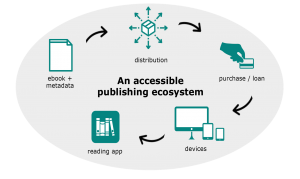
- the entire supply chain (retailers, e-commerce sites, hardware and software reading solutions, online platforms, DRM solutions) to make content available to users through accessible services;
- that detailed information on the accessibility of products and services is provided to end users in the distribution channels, allowing those with specific reading requirements to make informed purchasing decisions by knowing the accessibility features.
STANDARDS
To achieve these results, it will be necessary to adopt the available international standards for accessibility (from formats to metadata) and to provide information concerning accessibility to end users.
Technical accessibility requirements are currently described in the Directive at high level in the legislation, but the Commission shall define more detailed standards either by requesting to EU standardization bodies to define EU harmonized standards or by adopting as technical specifications the standards currently in use in the sectors covered by the Directive.
As for the publishing world, the hope is that the Commission will adopt standards already widely used in the sector.
To support this choice, Fondazione LIA has prepared a detailed document that highlights how both EPUB (in relation to e-book formats) and ONIX and Schema.org (in terms of metadata) already meet the technical accessibility requirements set by the legislation.
Based on this document, the Federation of European Publishers (FEP) has published an open position paper to foster the adoption by the EU Commission of these industry standards as technical specifications for the Act implementation. You can find more information on this page:
THE ROLE OF METADATA
As previously mentioned, a key element will be to signal to users with disabilities the accessible titles available on the market: this is possible using metadata standards such as Schema.org and ONIX that allow to record information on the accessibility features of a digital publication.
In Italy, Fondazione LIA has created the LIA catalogue and provides the information to the national e-books in print catalogue (ekitab) managed by Informazioni Editoriali using ONIX.
EXCEPTIONS
The legislation foresees some possible exceptions:
- for microenterprises i.e., enterprises with less than 10 employees and which have an annual turnover not over EUR 2 million or an annual balance sheet total not exceeding EUR 2 million;
- when producing an accessible version causes a disproportionate burden
- when a fundamental alteration of the content of the product would be required to create an accessible version.
In these cases, in order to justify the exception, it will be necessary to provide the competent authorities with detailed information and reports.
Furthermore, the accessibility of specific types of e-books such as comics, children’s books, and art books should be considered in the light of the applicable accessibility requirements. Market Surveillance Authorities, both at European and national level, will be responsible for checking the compliance of products and services with the requirements of the Directive.
The Directive explicitly provides a list of reasons that are considered illegitimate for the purposes of the exemption:
- lack of priority;
- lack of time;
- lack of knowledge.
2. The Marrakesh Treaty
The Marrakesh Treaty[2] is one of the treaties managed by the World Intellectual Property Organization (WIPO). It consists of a set of exceptions to copyright laws for well defined Authorized Entities for the creation of accessible versions of digital publications. It was approved in 2013 and entered into force on 30 September 2016.
In September 2017, the European Commission adopted a new Directive and a Regulation for the implementation of the Marrakesh Treaty in European laws, which define the procedures to check the possession of the requirements and compliance with the obligations of the Authorized Entities.
The beneficiaries
The beneficiaries of the treaty are:
- people with visual disabilities (blind and visually impaired);
- people with reading disabilities (dyslexia);
- people with physical disabilities that prevent them from handling a book, or from shifting their gaze to the extent that would normally be necessary for reading.
The content of the Treaty
The Treaty introduces a standard set of exceptions to copyright laws with the aim of allowing print impaired people and specialized organizations (called Authorized Entities) to carry out the creation of an accessible version of a book without asking the rights holders for authorization (as for the previous legislation). It also allows specialized organizations to distribute content in an accessible format not for profit, including cross-border distribution between Authorized Entities. In both cases, the beneficiaries must have legitimate access to the work from which the accessible version derives and they must operate not for profit.
In Italy there is a clause which states that the copyright exception does not apply if an accessible version of the text is already available on the market. However, the Authorized Entities must be informed of their existence.
The Authorized Entities
Any organization, both public or private, e.g. a public body or a non-profit organization, that provides beneficiaries with education, training, adapted reading or access to information as their primary business, or institutional obligation or as part of their public interest missions, can become an Authorized Entity. These organizations must then provide the said services to the beneficiaries without profit, and must be recognized or authorized according to the regulations in force.
The Authorized Entities may also reproduce, on a non-profit basis, copies of entertainment, information or educational works in an accessible format, and then distribute them across national borders through non-commercial lending channels or through electronic communications. In order to carry out these activities, the Authorized Entities must have legitimate access to the original works: they have to only introduce the changes necessary to make the work accessible and provide copies for the use of the beneficiaries only.
—
[1] “Directive (EU) 2019/882 of the European Parliament and of the Council of 17 April 2019 on the accessibility requirements for products and services”: https://ec.europa.eu/social/main.jsp?catId=1202
[2] “Marrakesh Treaty to Facilitate Access to Published Works for Persons Who Are Blind, Visually Impaired or Otherwise Print Disabled”: http://www.wipo.int/treaties/en/ip/marrakesh/